
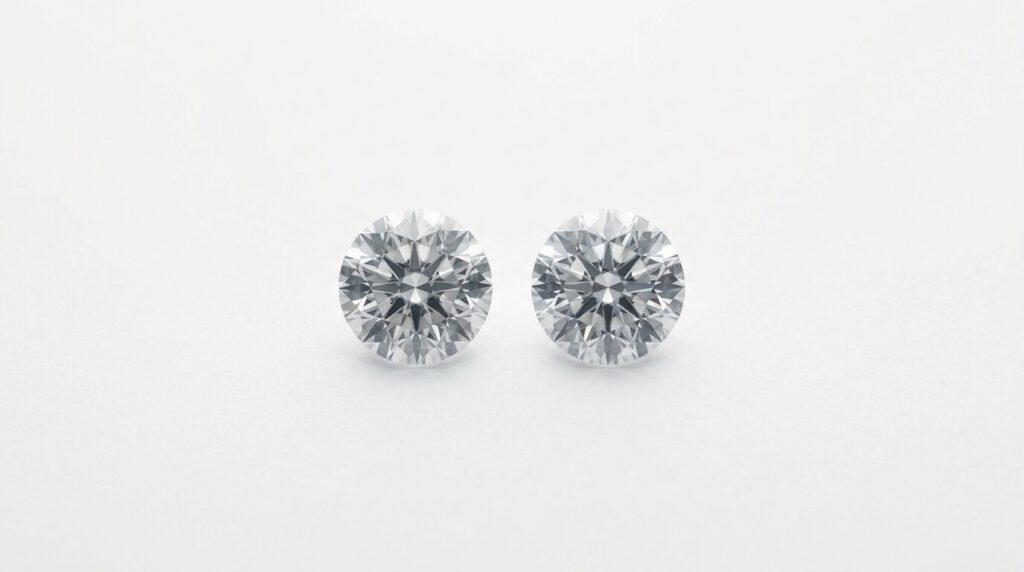
The question is rarely “which is the real diamond” — both are. The real question is which one to spend money on. This comparison goes through the properties that are identical, the ones that genuinely differ, and how each difference should weigh on a decision depending on what you want from the purchase.
Lab grown and natural diamonds are the same material: crystallised carbon, 10 on the Mohs scale, graded on the same 4Cs. They differ in origin, price and resale. A lab grown diamond of a given specification costs substantially less, which usually means a larger or better-graded stone for the same budget. A natural diamond holds more of its value on resale, though neither is a good investment.
What Is Identical
This part is not a matter of opinion. Both stones are pure carbon in a cubic crystal lattice, and that shared structure produces shared behaviour.
- Hardness: both are 10 on the Mohs scale, the hardest known natural material.
- Refractive index and dispersion: both return light the same way, so sparkle and fire are the same.
- Grading: both are assessed on carat, colour, clarity and cut by independent laboratories.
- Durability in wear: neither clouds, fades or scratches in normal use.
- Appearance to the eye: they cannot be distinguished visually, even by a jeweller with a loupe.
Because identification requires laboratory instruments, nobody looking at a ring on a hand can tell which they are seeing. That fact underlies much of the decision below.
What Genuinely Differs
| Lab Grown | Natural | |
|---|---|---|
| Origin | Grown in a controlled chamber over weeks | Formed underground over geological time |
| Price for comparable specs | Substantially lower | Higher |
| Size available for a given budget | Larger | Smaller |
| Resale value | Low | Low, but higher than lab grown |
| Supply | Production can scale to demand | Finite, dependent on mining |
| Certificate wording | States laboratory grown | States natural origin |
| Laser inscription | Usually identifies it as lab grown | Report number |
Everything in that table follows from one thing: production. A stone that can be grown to order behaves differently in a market than one that has to be found.
The Price Difference and What to Do With It
The price gap is the single most consequential difference for most buyers. A lab grown diamond of a given carat, colour and clarity generally costs far less than a natural stone of the same specification.
That gap can be spent in three different directions, and it is worth deciding deliberately which one you want:
- Go larger. The same budget buys more carat weight. This is what most buyers do.
- Go better. Keep the size you planned and move up in colour, clarity and cut grade instead.
- Spend less. Buy the specification you originally wanted and keep the difference.
There is no wrong answer, but there is a common mistake: spending the entire difference on carat weight and ending up with a large stone in a poorly executed setting. A well-cut stone in a well-made setting looks more expensive than a bigger stone in a cheap one.
We do not publish fixed price comparisons here, because our pricing is calculated live from current metal and stone costs. To see real numbers for a specification you care about, use the diamond inventory or the design tool.
Resale Value: The Honest Version
Diamonds in general are poor investments. The retail price of any diamond includes cutting, certification, distribution and retail margin, none of which is recoverable on resale. This is true of natural diamonds and has always been true.
Lab grown diamonds resell for less than natural ones. Buyers should assume that resale will recover only a fraction of what was paid, and should not treat the purchase as a store of value.
The practical conclusion is the same for both: buy a diamond because you want to own and wear it. If your goal is to preserve capital, a diamond is not the instrument for it — and any seller who suggests otherwise is overselling.
Origin and Ethics
Both supply chains have had legitimate scrutiny, and both have improved. Natural diamond sourcing has been the subject of long-running concerns about conflict financing and mining conditions, which led to certification schemes of varying effectiveness. Lab grown production avoids mining entirely but is energy intensive, and the energy source varies by producer.
The honest position is that neither option is automatically the ethical one, and specific claims are difficult to verify from a product listing. If this matters to you, ask sellers concrete questions about where stones are produced and what they can document, and treat unsupported marketing claims — on either side — with scepticism.
Which Should You Choose?
The decision usually resolves along a few clear lines.
Choose lab grown if
- You want the largest or best-graded stone your budget allows.
- You are buying to wear rather than to resell.
- You want a specific size or shape that would be out of reach otherwise.
- You prefer avoiding mined material.
Choose natural if
- Geological origin itself matters to you, as a story or a heirloom consideration.
- You expect to resell or trade up, and want to recover more of the outlay.
- You are buying into a family tradition where origin carries meaning.
Both are diamonds. The choice is about what you want the purchase to do.
Buyer Decision Box
- Decide in advance whether the price difference goes to size, quality, or savings — before you start comparing stones.
- Ask for the grading report on any stone, and check it names the origin explicitly.
- Compare cut grade and measurements, not just carat weight and colour letter.
- Do not buy either type as an investment. Assume you will not recover the price.
- Budget for the setting, not just the stone. A poor setting undoes a good diamond.
- If ethics drive the decision, ask for documentation rather than relying on marketing wording.
Myth vs Fact
| Myth | Fact |
|---|---|
| A jeweller can tell them apart at a glance. | No. Identification requires laboratory instruments. Neither type is visually identifiable in a ring. |
| Lab grown diamonds are a passing fad. | They are an established, independently graded product category with its own reporting standards. |
| Natural diamonds are a safe investment. | Retail diamonds of any origin lose most of their value on resale. |
| Lab grown diamonds have no inclusions. | They form with inclusions and colour variation, which is why they are graded at all. |
| Lab grown means lower quality. | Quality is set by the individual stone’s grades and cut, not by origin. |
FAQ
Are lab grown diamonds real diamonds?
Yes. They are crystallised carbon with the same structure, hardness and optical properties as mined diamonds, graded on the same 4Cs.
Can anyone tell the difference by looking?
No. The two are visually indistinguishable, including under a standard jeweller’s loupe. Identification requires laboratory instruments.
How much cheaper are lab grown diamonds?
Substantially, for a comparable specification, though the gap varies by size, shape and grade. Because our prices are calculated live, the reliable way to compare is to look up the specification you want in our inventory.
Do lab grown diamonds hold their value?
No. Resale recovers only a fraction of the purchase price, and less than for natural diamonds. Neither should be bought as an investment.
Will a lab grown diamond pass a diamond tester?
Yes. Standard thermal and electrical testers confirm the stone is diamond, because it is. They do not distinguish origin.
Which is more ethical?
Neither is automatically so. Lab grown avoids mining but is energy intensive; natural sourcing has improved but varies. Ask for specifics rather than relying on claims.
Final Buying Note
Both stones are diamond. The decision comes down to what you want from the money: more size and quality now, or more of the value retained later — recognising that neither retains much.
If you have decided on lab grown, compare certified stones in our inventory, browse ring styles, or start a custom design.
© VANTYRE Jewelry Guide