
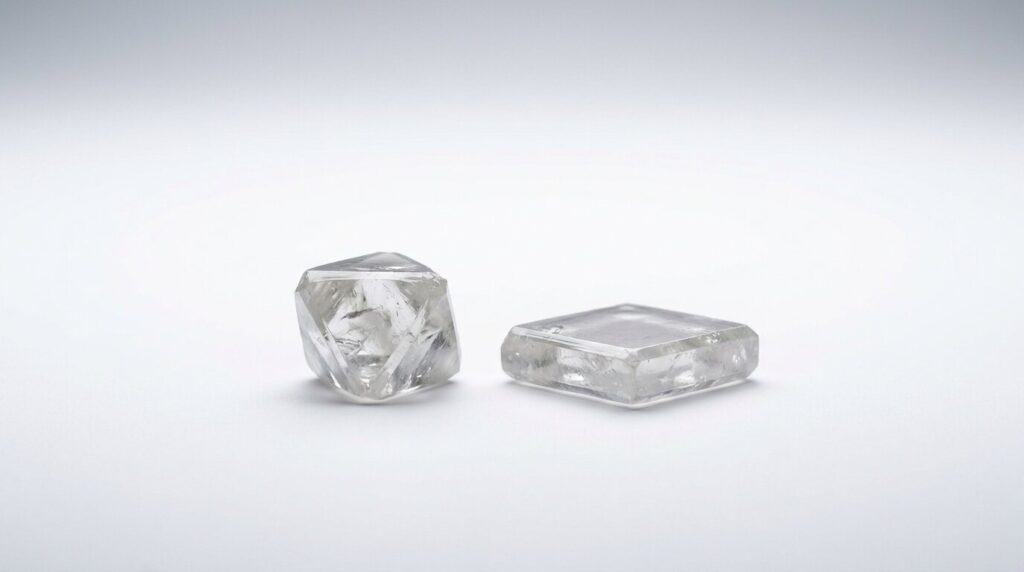
Every lab grown diamond on the market was produced by one of two processes: High Pressure High Temperature (HPHT) or Chemical Vapour Deposition (CVD). Both produce genuine diamond. They differ in how the crystal is formed, what kinds of inclusions tend to appear, and how often the stone is treated after growth. This guide explains both, and answers the question most buyers actually have — whether the method should influence which stone you choose.
HPHT grows a diamond by recreating the pressure and heat found deep underground. CVD grows it from carbon-rich gas at low pressure, layer by layer. Both produce real diamond that is graded on the same 4Cs. For a buyer comparing finished, certified stones, the growth method is far less important than cut quality, measurements and the grades on the report.
How HPHT Works
HPHT is the older of the two methods. A diamond seed is placed in a growth cell together with a carbon source and a metal flux that helps carbon dissolve and recrystallise. The cell is put under extreme pressure and heated, and carbon crystallises onto the seed.
Because carbon is deposited on many crystal faces at once, HPHT stones tend to grow in a cuboctahedral form — a shape with both cubic and octahedral faces. Growth is relatively fast once conditions are stable.
The metal flux is the source of the characteristic inclusion type. Small metallic inclusions can be trapped in the crystal, and in stones where these are numerous enough, the diamond can respond faintly to a strong magnet. This is a curiosity rather than a defect, and stones with visible inclusions are graded accordingly.
How CVD Works
CVD takes the opposite approach: low pressure, high temperature, and gas rather than flux. A thin diamond seed plate sits in a vacuum chamber filled with a carbon-rich gas, typically a hydrogen and methane mixture. Energy applied to the chamber breaks the gas apart, and carbon settles onto the seed plate in layers.
Because the crystal builds upward from a flat plate, CVD stones tend to grow in a tabular, block-like form rather than a cuboctahedron. Growers can pause the process, examine the crystal, and resume — which gives more control, and is one reason CVD has become common for larger stones.
CVD’s characteristic issue is colour. Stones can emerge with a brown or grey tint, which is why many CVD diamonds are given a post-growth HPHT treatment to improve the colour. That treatment is standard practice in the industry and is stable and permanent.
Post-growth treatment is one reason the two methods are not entirely separate in practice. A stone can be grown by CVD and then treated by HPHT. A reputable grading report notes the growth method and any treatment it detects.
HPHT vs CVD Side by Side
| HPHT | CVD | |
|---|---|---|
| Conditions | Very high pressure, high temperature | Low pressure, high temperature |
| Carbon source | Solid carbon with a metal flux | Carbon-rich gas, typically methane and hydrogen |
| Typical growth form | Cuboctahedral | Tabular, layer by layer |
| Characteristic inclusions | Metallic flux inclusions | Graphite or pinpoint inclusions, internal strain |
| Common post-growth treatment | Less often needed | Frequently HPHT-treated to improve colour |
| Is the result diamond? | Yes | Yes |
| Graded on the 4Cs? | Yes | Yes |
Read that table with one thing in mind: it describes tendencies, not rules. A well-grown CVD stone may have a cleaner clarity grade than a mediocre HPHT stone, and vice versa. The grading report describes the individual stone, and that is what you are buying.
Does the Growth Method Affect Quality?
Not in the way most buyers expect. Neither method is inherently superior, and neither produces a stone that is more or less of a diamond than the other.
What determines how a finished stone looks is the same set of factors that determines it for a mined diamond: the cut quality, the proportions, the colour grade, the clarity grade, and the actual measurements. A stone with an excellent cut will outperform a poorly cut one regardless of which chamber it grew in.
This is why our own diamond inventory shows the growth type as one column among many, alongside cut, polish, symmetry and measurements. It is information worth having, not a filter most buyers should lead with.
If you are still working out which grades to prioritise, the more useful reading is our guide to what lab grown diamonds are and how they are graded.
Can a Laboratory Tell Which Method Was Used?
Yes. Gemmological laboratories identify the growth method using instruments that examine internal growth patterns, strain, fluorescence behaviour and trace elements. These features are not visible with a loupe and are not something a buyer can assess by eye.
IGI reports for lab grown diamonds state the growth method. If you want to know how a stone was produced, the report is where to look — not the seller’s description.
Buyer Decision Box: Should the Growth Method Change Your Choice?
- Comparing two certified stones with similar grades? The growth method is not the deciding factor — compare cut grade and measurements first.
- Want to know whether a stone was treated after growth? Check the report, which notes the growth method and detected treatments.
- Concerned about metallic inclusions? Read the clarity grade and the plotted inclusions rather than filtering by method.
- Buying a larger stone? CVD is common at larger sizes, but this is a production reality, not a quality signal.
- Unsure either way? Prioritise cut quality. It affects appearance more than anything else on the report.
Myth vs Fact
| Myth | Fact |
|---|---|
| CVD diamonds are not real diamonds. | Both CVD and HPHT produce genuine diamond, identical in composition and structure to mined diamond. |
| HPHT diamonds are always better quality. | Neither method guarantees quality. Individual grades and cut decide how a stone looks. |
| A treated diamond is a damaged diamond. | Post-growth HPHT treatment to improve colour is standard, stable and permanent. It is disclosed on the report. |
| You can tell the growth method by looking at the stone. | No. Identification needs laboratory instruments that examine growth structure and trace elements. |
| The growth method affects durability. | It does not. Both produce diamond at 10 on the Mohs scale. |
FAQ
What does HPHT stand for?
High Pressure High Temperature. It is a growth method that recreates the pressure and heat conditions under which diamonds crystallise underground, and it is also used as a post-growth colour treatment.
What does CVD stand for?
Chemical Vapour Deposition. Carbon-rich gas is energised in a vacuum chamber and carbon settles onto a diamond seed plate in layers.
Which is better, HPHT or CVD?
Neither. Both produce genuine diamond graded on the same scales. Cut quality, measurements and the grades on the report matter far more to how a finished stone looks.
Are CVD diamonds always treated?
Not always, but post-growth HPHT treatment to improve colour is common for CVD stones. Any treatment detected is noted on the grading report.
Does the growth method appear on an IGI certificate?
Yes. IGI reports for lab grown diamonds state the growth method, and our inventory listings show it as a column.
Do HPHT diamonds contain metal?
Some contain small metallic inclusions from the flux used during growth. Where present, these are reflected in the clarity grade.
Final Buying Note
HPHT and CVD are two routes to the same material. Knowing which was used is useful context, but it is not the thing that decides how a diamond looks on a hand.
Compare stones on cut, measurements and certified grades in our IGI certified inventory, then look at ring styles or start a custom design.
© VANTYRE Jewelry Guide