
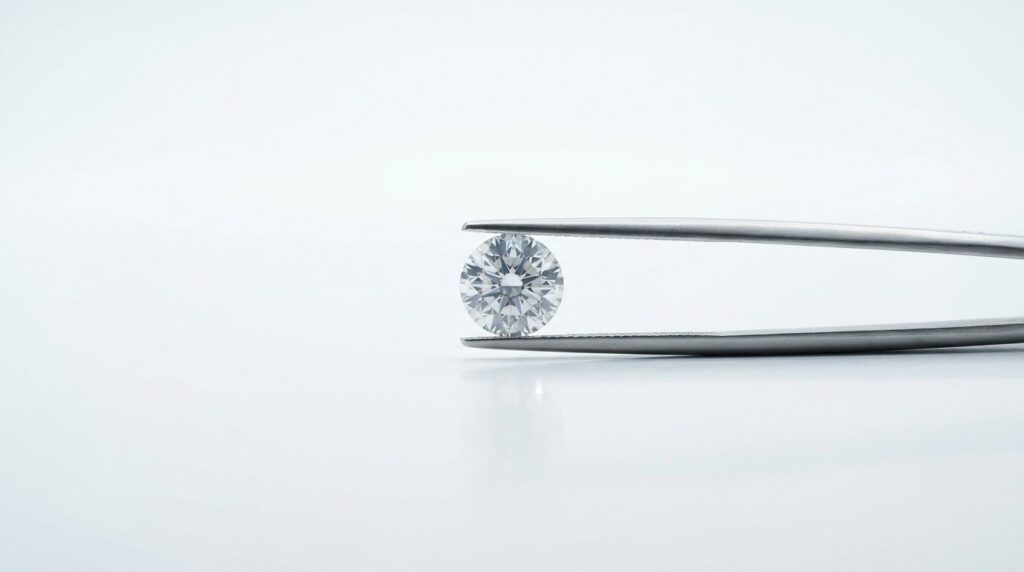
A lab grown diamond is a real diamond. It has the same carbon crystal structure, the same hardness, and the same optical behaviour as a diamond formed underground. The difference is where it was made, not what it is. This guide explains how lab grown diamonds are produced, how they are graded, how they differ from diamond simulants, and what to check before you buy one.
A lab grown diamond is crystallised carbon produced in a controlled laboratory environment, either by High Pressure High Temperature (HPHT) or Chemical Vapour Deposition (CVD). It is chemically, physically and optically the same material as a mined diamond, and it is graded on the same 4Cs by the same laboratories. It is not a simulant like moissanite or cubic zirconia.
What Is a Lab Grown Diamond?
A diamond is pure carbon arranged in a cubic crystal lattice. That structure is what gives a diamond its hardness, its refractive index, and the way it returns light to the eye. A lab grown diamond has exactly that structure.
Because the material is the same, a lab grown diamond behaves the same way in daily wear. It sits at 10 on the Mohs hardness scale, the same as a mined diamond. It can be cut into the same shapes, set in the same settings, and cleaned the same way.
The term you will see on a grading report is laboratory-grown diamond. Terms like “synthetic diamond” or “cultured diamond” refer to the same product, but grading laboratories have moved toward the clearer wording. If a seller avoids naming the origin at all, that is worth asking about.
How Lab Grown Diamonds Are Made
There are two production methods in commercial use, and they produce the same end material by different routes.
HPHT: High Pressure High Temperature
HPHT recreates the pressure and heat conditions under which diamonds crystallise underground. A small diamond seed is placed with a carbon source in a press, and carbon crystallises onto the seed. HPHT is also used as a post-growth treatment to improve the colour of stones grown by the other method.
CVD: Chemical Vapour Deposition
CVD grows a diamond from carbon-rich gas inside a vacuum chamber. The gas is energised, carbon atoms settle onto a seed plate layer by layer, and the crystal builds upward. CVD gives growers more control over the conditions, which is one reason it has become common for larger stones.
Neither method is inherently better for a buyer. What matters on the finished stone is the cut quality, the colour and clarity grades, and the certificate — not which chamber it grew in. If you want the detail, see our guide to reading an IGI certificate.
Lab Grown vs Natural Diamonds: What Actually Differs
The honest comparison is short, because most of the properties are identical.
| Property | Lab Grown Diamond | Mined Diamond |
|---|---|---|
| Chemical composition | Pure carbon | Pure carbon |
| Crystal structure | Cubic | Cubic |
| Hardness (Mohs) | 10 | 10 |
| Sparkle and fire | Same optical properties | Same optical properties |
| Graded on the 4Cs | Yes | Yes |
| Origin | Grown in a controlled chamber | Formed underground |
| Typical price for comparable specs | Substantially lower | Higher |
| Resale value | Low | Low, but generally higher than lab grown |
The two rows that matter to a buying decision are the last two. A lab grown diamond of a given carat, colour and clarity generally costs far less than a mined stone of the same specification, which is why many buyers can move up in size or quality within the same budget.
How Lab Grown Diamonds Are Graded
Lab grown diamonds are graded on the same four criteria as mined diamonds — carat, colour, clarity and cut. The reports are issued by independent gemmological laboratories, and the report states clearly that the stone is laboratory grown.
Most lab grown diamonds on the market carry an IGI report. Every stone in our own lab grown diamond inventory is IGI certified — we do not list stones graded by other laboratories.
Graded lab grown diamonds also carry a laser inscription on the girdle, usually the report number together with wording that identifies the stone as laboratory grown. The inscription is microscopic and invisible in normal wear, but it lets the stone be matched back to its report.
A certificate describes a stone; it does not rank sellers. Two stones with identical grades can still look different, because grading bands cover a range. When you can, compare measurements and cut grade rather than colour and clarity alone.
What a Lab Grown Diamond Is Not
This is where most confusion happens. A lab grown diamond is a diamond. A simulant only looks like one.
| Material | What it is | Hardness (Mohs) |
|---|---|---|
| Lab grown diamond | Diamond — crystallised carbon | 10 |
| Moissanite | Silicon carbide, a different material | About 9.25 |
| Cubic zirconia | Zirconium dioxide, a different material | About 8 to 8.5 |
Moissanite and cubic zirconia are legitimate products sold honestly by many jewellers, but they are not diamonds and are not graded on diamond scales. Moissanite in particular has higher dispersion, which produces a more rainbow-coloured flash that some buyers like and others do not. If a listing quotes a diamond colour and clarity grade, ask which laboratory issued the report.
What to Know Before You Buy
Three things are worth being clear about before you spend money.
Resale value is low — for all diamonds
Diamonds in general are poor investments, and lab grown diamonds resell for less than mined stones. Buy one because you want to wear it, not as a store of value. Any seller who presents a diamond as an investment is overselling it.
Grading bands cover a range
A stone graded VS1 sits somewhere within the VS1 band, not at a single fixed point. This is why two stones with the same grades can differ visibly, and why cut quality and measurements deserve as much attention as the colour and clarity letters.
The setting matters as much as the stone
A well-graded diamond in a poorly executed setting will not look expensive. Prong alignment, polishing and symmetry decide whether the finished piece feels finished. You can browse ring styles or start a custom design to see how a stone and a setting work together.
Buyer Decision Box: What to Check on a Lab Grown Diamond
- Is there an independent grading report, and does the report number match the stone?
- Does the report state clearly that the diamond is laboratory grown?
- What is the cut grade? On a round stone this affects appearance more than a single colour or clarity step.
- What are the actual measurements in millimetres? Carat weight alone does not tell you how large the stone looks face-up.
- For fancy shapes, what is the length-to-width ratio, and does it suit the outline you want?
- Does the setting suit how you will actually wear the piece day to day?
Myth vs Fact
| Myth | Fact |
|---|---|
| Lab grown diamonds are fake diamonds. | They are diamonds. Same carbon structure, same hardness, graded on the same scales by the same laboratories. |
| A jeweller can spot a lab grown diamond by eye. | No. Distinguishing lab grown from mined requires specialised instruments that detect growth patterns and trace elements. |
| Lab grown diamonds cloud, scratch or fade over time. | No. The material is diamond and does not degrade. Any diamond can be chipped by a hard knock on the girdle. |
| Lab grown diamonds are all flawless. | No. They form with inclusions and colour variation just as mined diamonds do, which is why they need grading at all. |
| Lab grown diamonds hold their value. | No. Resale is low. This is true of diamonds generally, and more so for lab grown. |
FAQ
Are lab grown diamonds real diamonds?
Yes. A lab grown diamond is crystallised carbon with the same structure, hardness and optical properties as a mined diamond. It is graded on the same 4Cs and described as a laboratory-grown diamond on its report.
What is the difference between HPHT and CVD?
They are two production methods. HPHT recreates high pressure and temperature conditions; CVD grows the crystal from carbon-rich gas. Both produce diamond. The method does not determine quality — the grades and cut do.
Can you tell a lab grown diamond apart from a mined one?
Not by eye, and not with a standard jeweller’s loupe. Identification requires laboratory instruments. This is one reason graded stones carry a laser inscription linking them to their report.
Do lab grown diamonds get cloudy over time?
No. Diamond does not degrade in normal wear. A ring that looks dull almost always needs cleaning, since skin oils and soap film build up under the stone.
Are lab grown diamonds worth buying?
They are worth buying if you want the material and appearance of a diamond and care more about how it looks than about resale. They are not a financial investment, and no diamond should be bought as one.
Is a lab grown diamond graded by IGI or GIA?
Both laboratories grade lab grown diamonds. IGI reports are the most common in the lab grown market. Every stone we list is IGI certified.
Final Buying Note
A lab grown diamond is a diamond. The decision is not about whether the material is real — it is about specification, cut quality, certification, and what the finished piece will look like on a hand.
If you are comparing stones, start with our IGI certified lab grown diamond inventory. If you already know roughly what you want, you can look at ring styles or begin a custom design.
© VANTYRE Jewelry Guide