
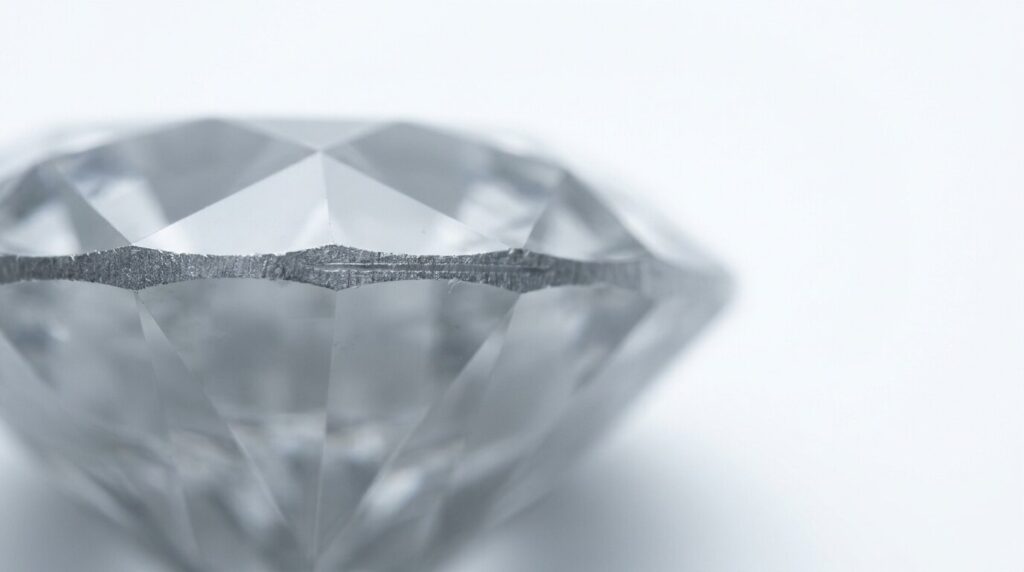
Graded lab grown diamonds carry a line of microscopic text on the girdle — the narrow band around the widest part of the stone. It is invisible in normal wear and does an important job: it ties a specific physical stone to a specific grading report. Here is what it says and how to use it.
A laser inscription is microscopic text on the diamond’s girdle, normally the grading report number together with wording identifying the stone as laboratory grown. It is applied by the grading laboratory, is invisible to the naked eye, and does not affect the diamond’s appearance, durability or grades. Its purpose is to let anyone match the stone back to its report.
What the Inscription Actually Says
There are usually two elements, sometimes on the same line:
- The report number, matching the number printed on the grading report.
- An origin identifier, such as wording indicating the stone is laboratory grown, or the abbreviation LG.
Some inscriptions include the laboratory’s name or logo. Retailers occasionally add a separate personalised inscription, but that is a different service from the laboratory’s own identifying mark and does not replace it.
The origin element matters. Disclosure guidance in major markets expects laboratory-grown stones to be identified as such, and an inscription is one of the ways that disclosure travels with the stone rather than only with the paperwork.
Where It Is and Why There
The inscription sits on the girdle — the thin outer edge where the upper and lower halves of the stone meet. That location is chosen for two reasons.
First, the girdle is covered or partly covered by the setting in most ring designs, so an inscription there is never visible in wear. Second, the girdle is not an optically active surface in the way the crown and pavilion facets are, so marking it does not interfere with how light travels through the stone.
The text is measured in microns. Under normal viewing conditions it cannot be seen at all.
How to See It
A standard 10x jeweller’s loupe is often not enough. Most inscriptions need higher magnification, good lighting and the stone held at the right angle — which is why jewellers use a microscope or a purpose-made inscription viewer.
If you are buying in person, ask to see the inscription. It takes a moment and lets you match the number against the report in front of you.
If you are buying online, ask your jeweller to check it when the stone is being set, or have it verified before your return window closes. For loose stones in our inventory, the certificate number shown in the listing is the number that should appear on the girdle.
Do not expect to find it yourself with a pocket loupe and give up when you cannot. Failing to see an inscription with inadequate magnification is not evidence that it is absent.
What the Inscription Does Not Do
It does not affect the diamond
The inscription does not weaken the stone, alter its grades, or change how it looks. It is applied after grading and is accounted for as a normal part of the process.
It does not prove the stone matches the report on its own
This is the important limitation. An inscription tells you which report the stone claims to belong to. Confirming that claim means checking the report on the laboratory’s own website and comparing the measurements and grades on the record against the stone. Our guide to verifying a certificate online covers the full sequence.
It does not identify origin by itself
The inscription reflects what the laboratory determined during grading. Determining that a stone is laboratory grown requires instruments; the inscription is the record of that determination, not the test.
Can an Inscription Be Removed or Faked?
An inscription can be polished off, because it is a surface marking on the girdle. Doing so removes a small amount of weight and would leave a stone whose paperwork no longer matches — which is why a stone with no inscription and a report claiming one should raise questions.
An inscription can also be added by anyone with the equipment, which is precisely why matching the number is only step one. The authoritative check is the laboratory’s own online record for that number, compared field by field against the stone’s actual measurements. A forged inscription pointing at a genuine report for a different stone fails that comparison on measurements.
In short: treat the inscription as a convenient index, and the laboratory’s online record as the evidence.
Buyer Decision Box
- Ask whether the stone is inscribed, and with what, before purchase.
- Match the inscription against the report number, and the report number against the laboratory’s own online record.
- Compare the online record’s measurements against the physical stone — this is what catches a mismatched report.
- Ask to see the inscription under magnification in person, or have your jeweller check it at setting.
- Do the check before the return window closes, not after.
- Keep the report with your insurance documents; the inscription is what links stone to paperwork if the two are separated.
Myth vs Fact
| Myth | Fact |
|---|---|
| A laser inscription damages or weakens the diamond. | It is a microscopic surface marking on the girdle and has no effect on durability, grades or appearance. |
| You can see the inscription with the naked eye. | No. It is measured in microns and usually needs more than a standard 10x loupe to read. |
| An inscription proves the stone matches its report. | It indicates which report is claimed. Verifying that claim means checking the laboratory’s online record and the measurements. |
| Every diamond is inscribed. | Not all are. Inscription is standard for graded lab grown diamonds but is not universal across all stones and laboratories. |
| An inscription can never be removed. | It can be polished off, which is why a missing inscription on a stone whose report specifies one is worth questioning. |
FAQ
What does the laser inscription on a lab grown diamond say?
Usually the grading report number together with wording identifying the stone as laboratory grown, sometimes with the laboratory’s name.
Where is the laser inscription located?
On the girdle, the narrow band around the widest part of the stone. In most settings this area is not visible in wear.
Can I see the inscription with a loupe?
Often not. A standard 10x loupe may be insufficient; jewellers typically use a microscope or a dedicated inscription viewer.
Does the inscription reduce the diamond’s value?
No. It is standard for graded stones and is applied by the laboratory as part of the grading process.
What if the inscription does not match the certificate?
Then the report does not belong to that stone. Do not proceed until the discrepancy is explained and resolved.
Can a laser inscription be removed?
Yes, by polishing, which removes a small amount of weight. A stone missing an inscription that its report specifies should be questioned.
Final Buying Note
The inscription is a small, well-designed piece of infrastructure: it keeps a stone connected to its paperwork through settings, resizings and changes of ownership. Use it as the starting point of verification rather than the end of it.
Every stone in our inventory is IGI certified with its report number listed. You can also browse ring styles or start a custom design.
© VANTYRE Jewelry Guide