
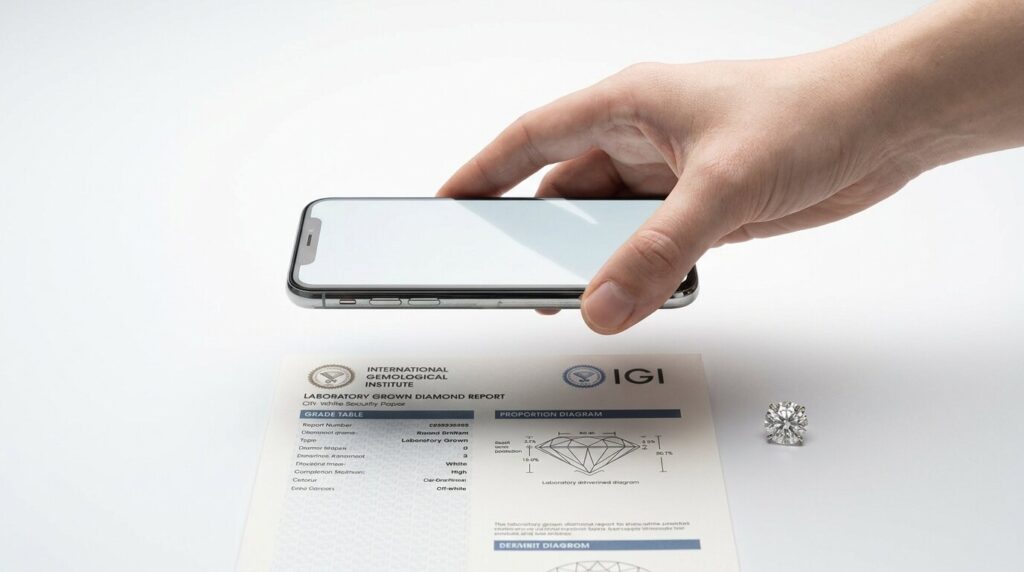
Illustrative example — sample grades shown, not an actual report for a stone in stock.
A grading report is only evidence if it is genuine and if it belongs to the stone in front of you. Both parts matter, and they fail in different ways. Verification takes a couple of minutes and is the single most useful check a buyer can perform. Here is how to do it properly.
Find the report number on the certificate, then enter it on the issuing laboratory’s own website — not on a link the seller provides. Compare every field on the online record against the paper or PDF report: shape, carat weight, colour, clarity, cut, measurements and origin. Then check that the laser inscription on the stone’s girdle matches the report number. A report that verifies but does not match the stone’s measurements is the most common real-world problem.
Step 1: Find the Report Number
Every graded stone has a unique report number, printed prominently on the certificate. For IGI reports it is usually shown at the top of the document, and the same number is repeated in the laser inscription on the diamond’s girdle.
If you are buying online, the report number should be visible in the listing itself before you commit to anything. In our inventory the certificate number is shown with each stone and links through to the certificate image.
A seller who will not supply the report number before purchase has given you your answer. There is no legitimate reason to withhold it.
Step 2: Verify on the Laboratory’s Own Site
This is the step people most often get wrong, and the error is subtle: they click the verification link the seller provided instead of navigating to the laboratory themselves.
Go to the issuing laboratory’s website directly by typing its address, find its report verification or report check page, and enter the number there. IGI and GIA both operate free public verification tools for exactly this purpose.
The reason to navigate yourself is that a link, a QR code or an embedded PDF can point anywhere, including to a convincing imitation of a laboratory site. Typing the address yourself removes that entire class of problem.
Verification is free at every recognised laboratory. If you are asked to pay to check a report number, you are not on the laboratory’s real site.
Step 3: Compare Every Field, Not Just the Number
A report number that returns a valid record is necessary but not sufficient. The record has to describe the stone you are actually buying.
Compare the online record against the document and the listing, field by field:
- Shape and cutting style — round brilliant, oval, emerald cut and so on.
- Carat weight — exactly, including decimals.
- Measurements in millimetres — length, width and depth.
- Colour and clarity grades.
- Cut, polish and symmetry grades where reported.
- Origin — the record should state laboratory-grown explicitly.
- Growth method and any disclosed post-growth treatment.
A mismatch anywhere is a stop signal. The most common genuine problem is not a forged report but a real report paired with a different stone — and measurements are what catch it, because they are specific to an individual diamond.
Step 4: Check the Laser Inscription
Graded lab grown diamonds carry a microscopic inscription on the girdle, normally the report number plus wording identifying the stone as laboratory grown. It is invisible to the naked eye and does not affect appearance.
A jeweller can show you the inscription under magnification. If you are buying in person, ask. If you are buying online, the inscription is one of the things to check when the stone arrives, before the return window closes.
An inscription that does not match the report number means the report does not belong to that stone, regardless of how genuine the report itself is.
What Can Actually Go Wrong
The report is genuine but belongs to another stone
The most common real problem. A seller supplies a valid report for a similar stone. Measurements and the laser inscription are what expose it.
The document has been altered
A grade changed on a PDF. Verifying against the laboratory’s own online record defeats this immediately, because the online record is the authoritative version.
The verification link is not the laboratory
A convincing imitation site that confirms whatever number is entered. Navigate to the laboratory yourself rather than following a supplied link.
There is no report at all
A stone described with colour and clarity grades but no laboratory report behind them. Those grades are then the seller’s own opinion, not an independent assessment.
Verifying After the Stone Arrives
Verification is not only a pre-purchase step. When a stone arrives, do three things before the return period expires:
- Re-run the report number on the laboratory site and confirm the record still matches.
- Have the laser inscription checked under magnification, or ask your jeweller to do it when the stone is set.
- Compare the physical measurements against the report if you have access to a gauge — or ask the jeweller setting the stone to confirm them.
For a set piece, ask for the report and any appraisal documents together, and keep them with your insurance paperwork.
Buyer Decision Box: Verification Checklist
- Get the report number before purchase, not after.
- Type the laboratory’s address yourself; never verify through a seller-supplied link or QR code.
- Match shape, carat, measurements, colour, clarity and origin against the online record.
- Confirm the record states laboratory-grown explicitly.
- Check the laser inscription against the report number before the return window closes.
- Treat any mismatch, or any refusal to supply the number, as a reason to walk away.
Myth vs Fact
| Myth | Fact |
|---|---|
| If the report number verifies, the stone is confirmed. | The number verifies the record exists. You still have to match the stone’s measurements and inscription to it. |
| A PDF certificate from the seller is proof enough. | Documents can be altered. The laboratory’s own online record is authoritative. |
| Verification costs money. | It is free at every recognised laboratory. Being asked to pay is a warning sign. |
| The laser inscription damages the diamond. | It is microscopic, on the girdle, and invisible in normal wear. |
| Only expensive stones need verification. | Verification is free and takes minutes. There is no size at which it stops being worth doing. |
FAQ
How do I check if a diamond certificate is real?
Enter the report number on the issuing laboratory’s own website, navigating there yourself rather than following a seller’s link, and compare every field on the online record with the document and the stone.
Where is the report number on a certificate?
It is printed prominently on the report, usually near the top, and is repeated as a laser inscription on the diamond’s girdle.
Does it cost anything to verify a report?
No. Recognised laboratories provide free public report verification. If you are asked to pay, you are not on the laboratory’s genuine site.
What if the measurements do not match the report?
Stop. A genuine report paired with a different stone is the most common problem in practice, and measurements are the field that reveals it.
Can I see the laser inscription myself?
Not with the naked eye. A jeweller can show it to you under magnification, and it is worth checking before a return window closes.
What if a stone has no certificate?
Then any grades quoted are the seller’s own opinion rather than an independent assessment. For a significant purchase, that is not sufficient.
Final Buying Note
Verification costs nothing and takes minutes, and it is the difference between a documented purchase and a trusting one. Do it before you pay, and check the inscription again when the stone arrives.
Every stone in our inventory is IGI certified with the report number shown and the certificate image linked. From there you can browse ring styles or start a custom design.
© VANTYRE Jewelry Guide