
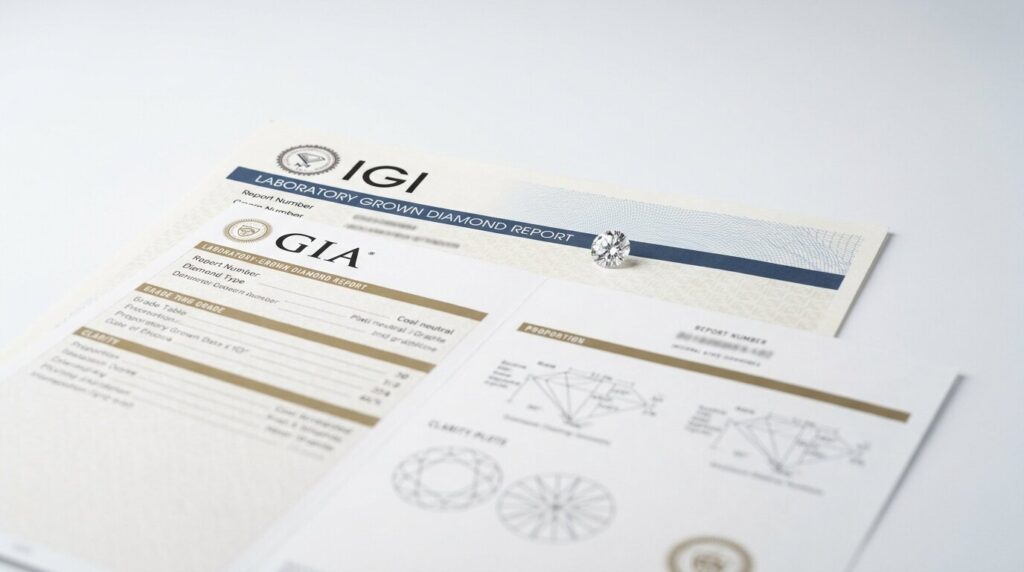
Illustrative example — sample grades shown, not an actual report for a stone in stock.
Both IGI and GIA are established, respected gemological laboratories, and a report from either is far better than no report at all. But they have taken different approaches to reporting lab grown diamonds, and that difference affects what you can compare. This guide explains what each report gives you and how to read grades across laboratories without misleading yourself.
Both are legitimate laboratories. IGI grades lab grown diamonds using the same point-by-point colour and clarity scales applied to natural diamonds, which is why most lab grown stones on the market carry IGI reports and why specifications are easy to compare. GIA has moved toward descriptive reporting for lab grown diamonds rather than the same letter-by-letter scales. Grades from different laboratories are not perfectly interchangeable, so compare stones within one laboratory’s reporting where you can.
Why Both Laboratories Are Legitimate
It is worth settling this first, because the question is often framed as though one laboratory must be the trustworthy one and the other suspect. That framing is wrong.
GIA developed the 4C grading system that the entire industry uses and has a long-standing reputation for consistency, particularly on natural diamonds. IGI operates globally, has graded lab grown diamonds at scale for longer than most laboratories, and issues the reports that accompany the majority of lab grown stones in the market.
The meaningful differences are about reporting approach and about consistency across laboratories generally — not about one being real and the other not.
The Reporting Difference That Matters
The practical difference for a buyer comparing stones is how the grades are expressed.
IGI reports lab grown diamonds using the familiar scales: a colour grade on the D-to-Z scale, a clarity grade from Flawless through the Included grades, a cut grade, plus polish, symmetry, fluorescence and measurements. This is the same vocabulary used for natural stones, so a listing can be compared directly against another IGI-reported stone.
GIA has moved toward describing lab grown diamonds in broader categories rather than assigning the same point-by-point letter grades it uses for natural diamonds. The reasoning relates to how lab grown stones are produced and how GIA views like-for-like comparison with mined material.
Laboratory reporting practices change over time, and both laboratories have revised their approach to lab grown diamonds more than once. Read what the specific report in front of you actually states rather than assuming what a laboratory’s reports contained a few years ago.
Why We Only List IGI Certified Stones
Our diamond inventory shows IGI certified stones only. That is a deliberate choice, and it is worth explaining rather than leaving as a quiet policy.
Point-by-point grades let you filter and compare. If one stone is reported as G colour VS1 and another as F colour VS2, you can weigh those against each other and against price. Descriptive categories do not support that kind of comparison in a search table.
Restricting to a single laboratory also removes a source of noise. Comparing a grade from one laboratory against a grade from another introduces a consistency question that a buyer cannot resolve from a listing. Within one laboratory’s reporting, comparison is much more meaningful.
This is not a claim that IGI grades are better than anyone else’s. It is a claim that consistent, comparable reporting is what a search table needs to be useful.
Cross-Laboratory Consistency: The Honest Caveat
Grading involves human judgement within defined bands, and laboratories are not perfectly interchangeable. The same stone submitted to two laboratories can come back with grades that differ by a step, particularly on colour and clarity where the boundaries between adjacent grades are narrow.
That is not evidence of dishonesty — it is a consequence of grading being an assessment rather than a measurement. But it has one practical implication: a colour or clarity grade is a reliable guide within a laboratory’s own reporting, and a looser guide when compared across laboratories.
Two habits follow from this. Compare stones reported by the same laboratory where you can. And weight cut grade and actual measurements heavily, because those are more objective than colour and clarity judgements.
What to Check on Any Report
Whichever laboratory issued it, the same checks apply:
- The report number, verified on the issuing laboratory’s own website rather than on a copy supplied by the seller.
- The origin statement, which should say explicitly that the diamond is laboratory grown.
- The growth method and any post-growth treatment disclosed.
- The measurements in millimetres, which tell you how large the stone will look face-up.
- The cut, polish and symmetry grades, which affect appearance more than a single colour step.
- The laser inscription, which should match the report number.
Our guide to reading an IGI certificate goes through each field in detail.
What Should Actually Drive the Decision
For most buyers the laboratory name is not the deciding factor, because both are credible. The things that change how a finished ring looks are:
- Cut quality, which determines light return more than any other single factor.
- Measurements, which determine visible size — see why two 1 carat stones can look different sizes.
- Shape and outline, which decide whether the stone suits the hand and the setting.
- The quality of the setting itself, which is not on any report.
A report is the evidence that the stone is what the listing says. It is not, by itself, a ranking of how good the stone will look.
Buyer Decision Box
- Insist on a report from a recognised laboratory, and verify the number on that laboratory’s own site.
- Compare stones reported by the same laboratory where possible, rather than mixing sources.
- Confirm the report states laboratory-grown origin explicitly.
- Weigh cut grade and millimetre measurements ahead of a single colour or clarity step.
- Check that the laser inscription matches the report number.
- Treat any stone offered without a report as unverified, whatever the seller says about it.
Myth vs Fact
| Myth | Fact |
|---|---|
| Only GIA reports can be trusted. | Both IGI and GIA are recognised laboratories. Reporting approach differs; legitimacy does not. |
| An IGI report means the stone is lower quality. | The report describes the stone. Quality is set by the grades and cut, not by which laboratory assessed them. |
| Grades mean exactly the same thing at every laboratory. | Grading is judgement within bands, so grades are most comparable within one laboratory’s own reporting. |
| A certificate guarantees the stone will look good. | It documents grades and measurements. Cut quality and the setting decide appearance. |
| A seller’s photocopy of a report is sufficient proof. | Always verify the report number on the issuing laboratory’s own website. |
FAQ
Is IGI as good as GIA?
Both are recognised laboratories. They differ in how they report lab grown diamonds — IGI uses the familiar point-by-point colour and clarity scales, while GIA has moved toward descriptive categories for lab grown stones.
Why do most lab grown diamonds have IGI reports?
IGI has graded lab grown diamonds at scale for longer than most laboratories, and its point-by-point reporting suits how lab grown stones are listed and compared.
Does GIA grade lab grown diamonds?
Yes, GIA issues reports for laboratory-grown diamonds. Its approach to expressing those grades has changed over time, so read what the specific report states.
Can two laboratories grade the same stone differently?
Yes, typically by a step on colour or clarity. Grading is an assessment within defined bands, not a physical measurement.
Which laboratory do you use?
Every stone in our inventory is IGI certified. We do not list stones graded by other laboratories, so that grades in the search table are consistent and comparable.
How do I verify a certificate?
Enter the report number on the issuing laboratory’s own verification page, and check that it matches the laser inscription on the stone’s girdle.
Final Buying Note
Both laboratories are credible. The practical question is not which name appears on the report, but whether you can compare stones meaningfully — which is easier within one laboratory’s reporting than across several.
Every stone in our inventory is IGI certified with its report number listed. From there you can look at ring styles or start a custom design.
© VANTYRE Jewelry Guide