
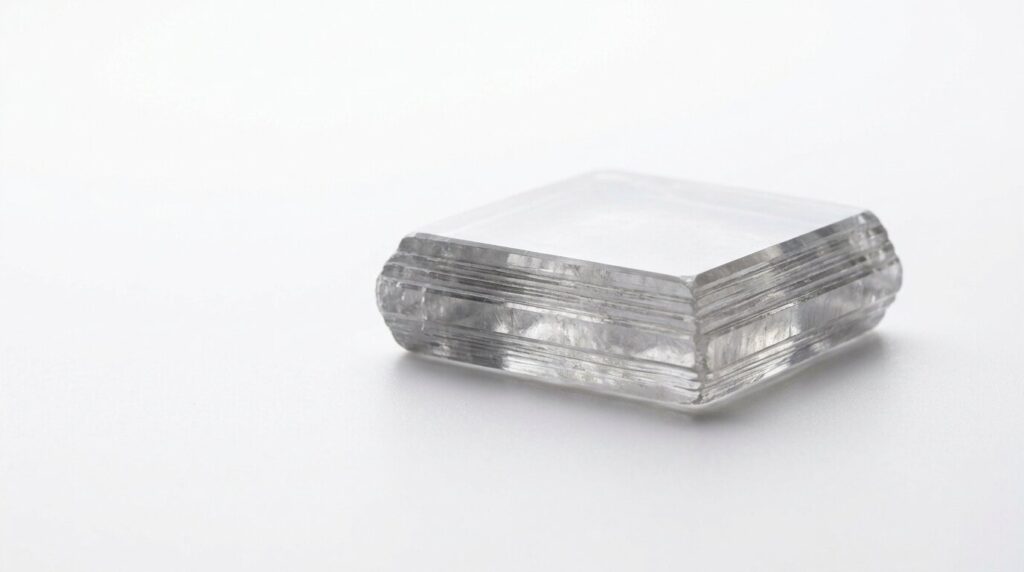
Growth itself is faster than most people expect, and it is also the shortest stage in getting a finished ring onto a hand. Cutting, grading and setting take longer than the crystallisation does. This guide covers both the growth timeline and the realistic timeline for an actual order.
A lab grown diamond typically takes from a few days to several weeks to grow, depending on the target size, the method and the quality being aimed for. Larger stones take longer, and the relationship is not linear. Growth is only one stage: cutting and polishing, grading and certification, and then setting the stone in a finished piece each add their own time.
Growth Time by Method
HPHT
Under high pressure and temperature, carbon crystallises onto the seed relatively quickly once conditions stabilise. Growth runs are generally measured in days to a couple of weeks for commercial sizes.
CVD
CVD builds the crystal in layers from carbon-rich gas, and the deposition rate is inherently slower per unit of material. Runs are commonly measured in weeks. The trade-off is control: growers can pause the process, inspect the crystal, and resume, which is part of why CVD is widely used for larger stones.
Neither timeline says anything about quality. A stone grown quickly is not inferior to one grown slowly — what matters is what the finished, cut stone measures and grades. See HPHT vs CVD for how the two methods differ in practice.
Why Bigger Takes Disproportionately Longer
Doubling the carat weight does not double the growth time — it usually costs more than that.
The reason is that a diamond grows outward in three dimensions. Adding weight to an already large crystal means depositing material across a much larger surface. Meanwhile the risk of a defect appearing rises with every additional hour of growth, and a defect that appears late in a long run can compromise a crystal that already represents substantial time and energy.
This compounding risk is a large part of why price per carat rises steeply with size, for lab grown and mined stones alike. It is also why larger stones cannot simply be produced on demand in unlimited quantity.
Why It Cannot Simply Be Rushed
Growth conditions have to stay within tight parameters. Pushing temperature or deposition rate to speed things up tends to produce crystals with more inclusions, more internal strain, or unwanted colour — all of which show up in grading, and some of which make a crystal unusable.
Growers therefore optimise for yield rather than speed. A slightly longer run that reliably produces a clean crystal is more economical than a fast run that frequently fails.
This is the practical answer to a common assumption: that production could be scaled arbitrarily and instantly. Capacity can be expanded by building more chambers, but each individual stone still takes the time it takes.
What Happens After Growth
The grown crystal is not a gem. Several stages follow, and together they take longer than growth did.
- Planning and cutting. The rough crystal is mapped to decide how to cut it for the best combination of yield and quality. Cutting and polishing is skilled work, and a significant share of the rough weight is lost in the process.
- Grading. The polished stone goes to an independent laboratory, is assessed on the 4Cs, laser inscribed, and issued with a report. Turnaround depends on the laboratory’s queue.
- Distribution. The certified stone enters inventory and becomes available to buyers.
- Setting. For a made-to-order piece, the setting is produced and the stone is set, followed by finishing and quality checks.
This is why a stone listed in our inventory shows a lead time. It is already grown, cut and certified — the lead time reflects sourcing and setting, not growth.
Compared With Natural Diamonds
Mined diamonds crystallised deep in the earth over geological timescales, then reached the surface through volcanic activity. The contrast between billions of years and a few weeks is the single most quoted fact about lab grown diamonds.
It is genuinely striking, but it says nothing about the material. Time under formation does not add hardness, brilliance or durability — the crystal structure is what does that, and it is the same structure either way. The formation time is a fact about history, not about the stone in your hand.
What the difference does explain is availability and price. Something that can be produced to order behaves differently in a market than something that must be found.
How Long Will Your Order Take?
For a buyer, the useful timeline starts after certification, not at growth.
A certified stone already in inventory needs to be sourced and set. A made-to-order setting takes time to produce, and details like engraving or a fully custom design add to it. Our listings show lead time per stone, and a custom design will have its own quoted schedule.
The realistic planning advice: if you are buying for a specific date, work backwards and allow more time than the minimum quoted, particularly if the design is custom or the ring may need resizing after delivery. You can begin a design at design your setting or browse finished ring styles.
Buyer Decision Box: Planning Your Timeline
- Check the lead time shown on the specific stone rather than assuming a general figure.
- Add time for setting production, which is separate from stone sourcing.
- Allow extra time for custom designs, engraving, or unusual specifications.
- Build in a buffer for resizing after delivery if the ring size is uncertain.
- If you need a specific date, work backwards from it and start earlier than the minimum.
- Do not compress the schedule so far that you skip verifying the certificate on arrival.
Myth vs Fact
| Myth | Fact |
|---|---|
| A diamond can be grown overnight. | Growth runs take days to weeks depending on size and method, and larger stones take disproportionately longer. |
| Faster growth means lower quality. | Quality is determined by the finished stone’s grades and cut, not by how long the run took. |
| Lab grown diamonds can be produced instantly on demand. | Each stone occupies a chamber for the duration of its growth. Capacity expands by building chambers, not by speeding up individual stones. |
| Billions of years of formation makes a natural diamond harder. | Both are 10 on the Mohs scale. Formation time does not change the crystal structure. |
| Once grown, a diamond is ready to sell. | Cutting, polishing, grading and certification all follow, and together take longer than growth. |
FAQ
How long does it take to grow a lab diamond?
Typically days to several weeks, depending on the target size, the growth method and the quality being aimed for. Larger stones take disproportionately longer.
Is CVD slower than HPHT?
Generally yes. CVD deposits material in layers from gas, which is slower per unit of material, but it gives growers more control and is widely used for larger stones.
Why do larger diamonds take so much longer?
Growth happens across a three-dimensional surface, so added weight requires disproportionately more material, and the risk of a defect increases with every additional hour of the run.
Can growth be sped up?
Pushing conditions harder tends to produce inclusions, strain or unwanted colour. Growers optimise for reliable yield rather than raw speed.
How long until I receive a finished ring?
That depends on the stone’s lead time plus setting production. Listings show lead time per stone, and custom designs are quoted separately.
Does growth time affect the price?
Indirectly. Longer runs occupy equipment for longer and carry more risk of failure, which is part of why price per carat rises steeply with size.
Final Buying Note
Growth is the fast part. If you are planning around a date, the stages that follow — cutting, certification, setting and any resizing — are what determine when a finished piece is actually on a hand.
Lead times are shown per stone in our IGI certified inventory. You can also browse ring styles or start a custom design.
© VANTYRE Jewelry Guide