
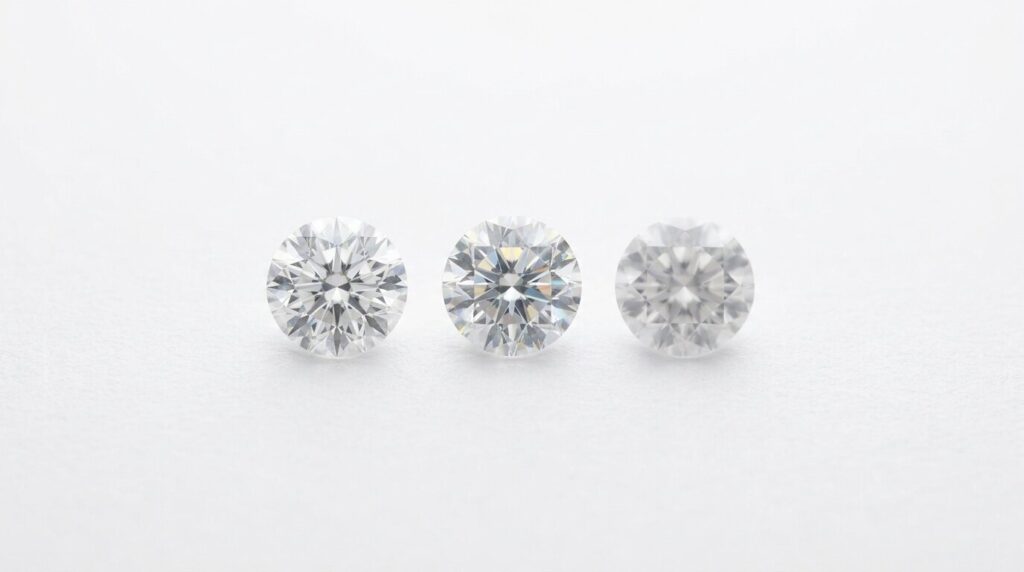
These three are often listed side by side as “diamond alternatives”, which is where the confusion starts. Only one of them is a diamond. The other two are separate materials with their own properties, their own optical behaviour and their own price levels. Understanding what actually separates them makes the choice straightforward.
A lab grown diamond is diamond — crystallised carbon, 10 on the Mohs scale, graded on the 4Cs. Moissanite is silicon carbide, about 9.25 on the Mohs scale, with roughly double the dispersion of diamond, which produces noticeably more rainbow flash. Cubic zirconia is zirconium dioxide, around 8 to 8.5, noticeably heavier for its size and prone to dulling over years of wear. Only the diamond is graded on diamond scales.
The Three Materials Compared
| Lab Grown Diamond | Moissanite | Cubic Zirconia | |
|---|---|---|---|
| Material | Carbon | Silicon carbide | Zirconium dioxide |
| Is it diamond? | Yes | No | No |
| Hardness (Mohs) | 10 | About 9.25 | About 8 to 8.5 |
| Dispersion (fire) | Moderate | Roughly double diamond | Higher than diamond |
| Weight for the same size | Baseline | Lighter than diamond | Noticeably heavier |
| Graded on the 4Cs? | Yes, by gem laboratories | No, graded on its own terms | No |
| Ages well? | Yes, does not degrade | Yes, very durable | Surface dulls over years |
| Relative price | Highest of the three | Mid | Lowest |
The row that matters most for long-term wear is the last one about ageing, and the row that most affects appearance is dispersion.
Lab Grown Diamond
A lab grown diamond is diamond in every respect that a material can be: same composition, same crystal structure, same hardness, same optical properties. It is graded on carat, colour, clarity and cut by independent laboratories, and the report states that it is laboratory grown.
Its sparkle profile is what people recognise as diamond — a balance of white light return (brilliance) and coloured flashes (fire), with fire present but not dominant.
For a fuller explanation, see what lab grown diamonds are and why they count as real diamonds.
Moissanite
Moissanite is silicon carbide. It occurs in nature only in vanishingly small quantities, so essentially all jewellery moissanite is laboratory produced. It is a legitimate gemstone sold honestly by many jewellers — it is simply not diamond.
Its defining optical characteristic is dispersion roughly double that of diamond. That produces a distinctly more colourful, rainbow-like flash, especially in direct light and at larger sizes. Some buyers love this; others find it reads as obviously not diamond. It is a matter of taste rather than quality, but it is worth seeing in person before deciding.
Moissanite is also doubly refractive, which means light entering the stone splits into two rays. Under magnification this can show as facet doubling — the back facet edges appear to have a faint twin. Diamond is singly refractive and does not do this.
At 9.25 on the Mohs scale it is very durable and holds up well to daily wear. Its practical drawback is not durability but the fact that it is not graded on diamond scales, so colour and clarity comparisons across sellers are less standardised.
Cubic Zirconia
Cubic zirconia is zirconium dioxide. It is the least expensive of the three by a wide margin, and it is genuinely convincing when new.
The problem is time. At around 8 to 8.5 on the Mohs scale it is considerably softer than the other two, and everyday contact with harder particles gradually abrades the facet edges and the surface. A CZ that looked bright when new tends to look cloudy and tired after a few years of constant wear. It also holds oils readily, which compounds the effect.
Cubic zirconia is also noticeably denser than diamond, so a CZ cut to the same dimensions as a diamond weighs appreciably more. Someone used to handling loose stones can often pick this up by feel.
None of this makes it a bad product for its purpose. For costume pieces, travel replicas of valuable rings, or trying out a shape before committing, it does its job well. It is not a material to build a piece meant to last decades around.
How to Tell Them Apart
What works
- A grading report. The reliable answer. A diamond report from a recognised laboratory names the material and the origin.
- A dual-purpose tester. Thermal-only testers can read moissanite as diamond. Testers that combine thermal and electrical conductivity separate the two.
- Magnification for facet doubling. Moissanite’s double refraction can show as doubled back facet edges. Diamond does not do this.
- Weight against measurements. If a stone’s millimetre size and its carat weight disagree markedly, the material may not be what is claimed — cubic zirconia is much heavier.
What does not work
- The breath test. Widely repeated, unreliable in practice.
- The scratch test. Damages the stone and proves little, since all three are hard enough to scratch glass.
- Judging by sparkle alone. Cut quality affects sparkle more than material does, and a well-cut CZ can outshine a poorly cut diamond when new.
- Price. A low price is a reason to ask for documentation, not proof of anything on its own.
If someone offers a stone as a diamond without a report from a recognised laboratory, that is the point to stop and ask for one. Every stone in our inventory is IGI certified, and the report number is shown with each listing.
Which One Should You Buy?
- Choose a lab grown diamond if you want a diamond that is independently graded, will not change over decades, and reads as diamond rather than as something with more colourful flash.
- Choose moissanite if you like the more rainbow-like fire, want strong durability at a lower cost, and are comfortable with a stone that is not graded on diamond scales.
- Choose cubic zirconia for costume pieces, travel replicas, or testing a shape and size before committing — not for a piece intended to last.
There is no dishonesty in any of these choices as long as the material is stated plainly. The problem is only ever a stone sold as something it is not.
Buyer Decision Box
- Ask what the material is, in writing, before paying.
- For anything sold as diamond, ask for the laboratory report and verify it on the laboratory’s own site.
- See moissanite in person in daylight before buying — its extra fire is very visible and is a matter of taste.
- For a piece meant to last decades of daily wear, treat cubic zirconia as unsuitable.
- Check the millimetre measurements against carat weight; a large mismatch is a warning sign.
- Remember cut quality affects sparkle more than material — compare stones cut to a similar standard.
Myth vs Fact
| Myth | Fact |
|---|---|
| Moissanite is a type of diamond. | It is silicon carbide, a completely different material, and is not graded on diamond scales. |
| Cubic zirconia and lab grown diamond are the same thing. | Cubic zirconia is zirconium dioxide and is much softer. A lab grown diamond is diamond. |
| A diamond tester proves a stone is a diamond. | Thermal-only testers can read moissanite as diamond. Use a dual thermal and electrical tester, or a report. |
| Moissanite sparkles more, so it is better. | It disperses more coloured light. Whether that looks better is personal taste, not a quality ranking. |
| Cubic zirconia lasts as long if you look after it. | Careful wear slows the dulling but does not prevent it. The material is simply softer. |
FAQ
Is moissanite a diamond?
No. Moissanite is silicon carbide, a different material with different optical properties. It is durable and legitimate, but it is not diamond and is not graded on diamond scales.
Can a jeweller tell moissanite from diamond?
Yes, easily, with a dual thermal and electrical tester or by looking for facet doubling under magnification caused by moissanite’s double refraction.
Does cubic zirconia get cloudy?
Yes, over years of regular wear. At around 8 to 8.5 on the Mohs scale it abrades gradually and holds oils, so it loses brightness in a way diamond does not.
Which sparkles more, moissanite or diamond?
Moissanite disperses roughly twice as much coloured light, so it shows more rainbow flash. Diamond shows more white brilliance. Neither is objectively better.
Is a lab grown diamond better than moissanite?
It is diamond, independently graded, and does not change over time. Whether it is better for you depends on budget and whether you prefer diamond’s sparkle profile.
How can I be sure I am getting a real diamond?
Buy a stone with a report from a recognised laboratory, check the report number against the laser inscription, and verify the report on the laboratory’s own website.
Final Buying Note
One of these three is a diamond, and the other two are honest products that are not. Whichever you choose, the important thing is that the material is stated clearly and, for a diamond, backed by an independent report.
Every stone in our inventory is IGI certified with the report number shown. You can also browse ring styles or start a custom design.
© VANTYRE Jewelry Guide