
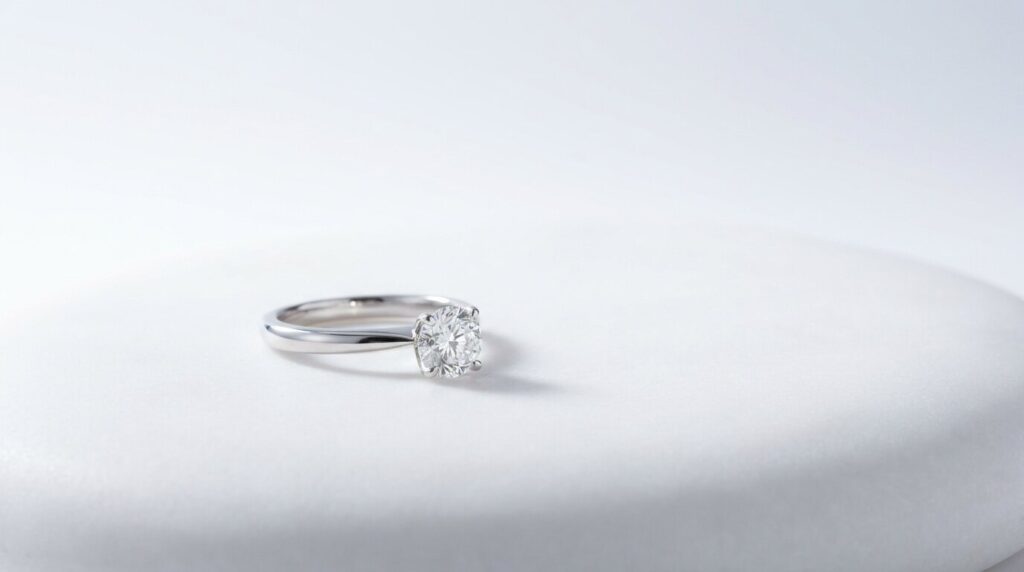
We sell lab grown diamonds, so it would be convenient to be vague about this. Instead, here is the straight answer: lab grown diamonds do not hold their value. Neither do natural diamonds, though they hold slightly more of it. Understanding why is genuinely useful, because it changes what you should optimise for when buying.
No. A lab grown diamond will resell for a fraction of its retail price. This is partly because retail price includes cutting, certification, distribution and margin that cannot be recovered, and partly because lab grown supply can expand with demand. Natural diamonds also lose most of their value on resale — the difference is one of degree. Buy a diamond to wear, not to store value.
Why Any Retail Diamond Loses Value
The price you pay at retail is not the price of the raw material. It includes a chain of costs that add value for you but cannot be recovered when you sell:
- Cutting and polishing, which typically removes a large share of the rough weight.
- Grading and certification by an independent laboratory.
- Distribution through wholesalers and retailers.
- Retail margin, premises, staffing and warranty obligations.
- In many countries, sales tax or VAT applied at purchase.
When you resell, you are selling into the wholesale side of that chain, not the retail side. A buyer who intends to resell your stone has to make their own margin on it. This is not unique to diamonds — it is the same reason a new car loses value the moment it is driven away.
Why Lab Grown Recovers Less Than Natural
Two additional factors apply specifically to lab grown stones.
Supply can respond to demand
A mined diamond has to be found. Production capacity for lab grown diamonds can be expanded — new chambers can be built, and growers have become more efficient over time. As capacity has grown, wholesale prices for lab grown stones have come down. That is good news for a buyer purchasing today and bad news for anyone hoping the stone they bought last year appreciated.
The secondary market is thin
There is no established resale market for lab grown diamonds comparable to what exists for natural stones. Fewer buyers means weaker prices. A stone that is easy to replace new is not one anyone needs to buy used.
This is a description of how the market currently works, not a prediction. We are not forecasting future prices in either direction, and you should be sceptical of any seller who does.
But Natural Diamonds Are Not an Investment Either
It is worth being clear that this is not a lab-grown-specific failing. The idea that a natural diamond is a store of value is largely a marketing inheritance rather than a market reality.
Someone selling a natural diamond privately or to a trade buyer typically recovers a fraction of the retail price too. The gap between retail and resale exists on both sides; it is simply wider for lab grown.
The categories of stones that genuinely appreciate are narrow and specialised — exceptional coloured diamonds, historically significant pieces, certain signed antique jewellery. A commercially graded white diamond of ordinary specification, of either origin, is not in that category.
What This Should Change About How You Buy
If resale is off the table, several buying decisions look different.
Optimise for how it looks, not for specification on paper
If you are not preserving value, there is no reason to pay for grades that are invisible in wear. Colour and clarity steps that make no visible difference to the eye are money spent on paper, and paper you cannot sell. Cut quality, by contrast, changes how the stone actually looks — that is where the money does something.
Buy the size and shape you actually want
The usual reason to hold back is a vague sense that a more conservative choice will be easier to resell. It will not be. Buy the outline you like.
Spend properly on the setting
A stone sits in a setting for its entire life. Prong quality, symmetry and finishing decide whether the piece looks well made. Under-spending here to fund a larger stone is the most common way to end up disappointed.
Insure it, do not bank on it
Insurance protects against loss or damage at replacement cost. That is the sensible financial mechanism for jewellery — not resale value.
When People Say a Diamond “Held Its Value”
Two things are usually going on when someone reports otherwise.
The first is inflation. A ring bought decades ago and appraised today at a higher nominal figure has not necessarily gained real value; an appraisal for insurance is a replacement-cost estimate, not an offer to buy.
The second is confusion between appraisal and market price. Appraised values are routinely higher than what anyone will actually pay. If you want to know what a stone is worth on resale, the honest test is what a buyer offers, not what a document says.
Buyer Decision Box: Buying With Resale Off the Table
- Set a budget you are comfortable treating as spent, not invested.
- Prioritise cut quality — it is the grade that visibly changes how the stone looks.
- Do not pay for colour or clarity steps that are invisible in the setting you have chosen.
- Choose the shape and size you actually want, not the one you think resells best.
- Allocate enough of the budget to the setting and finishing.
- Insure the piece at replacement cost, and keep the grading report with your policy documents.
Myth vs Fact
| Myth | Fact |
|---|---|
| Natural diamonds are a safe investment. | Retail diamonds of any origin resell for a fraction of their purchase price. |
| Lab grown diamonds are worthless. | They are not worthless — they are simply worth much less than retail on resale, like most jewellery. |
| An appraisal tells you what your diamond is worth. | An appraisal usually estimates replacement cost for insurance. It is not an offer to purchase. |
| A certificate protects the value. | A certificate documents the stone’s grades. It does not create a resale market or set a price. |
| Buying a larger stone protects value better. | Size does not change the retail-to-resale gap. It only increases the amount exposed to it. |
FAQ
Do lab grown diamonds hold their value?
No. They resell for a fraction of retail price. Retail price includes cutting, certification, distribution and margin that cannot be recovered, and lab grown supply can expand with demand.
Do natural diamonds hold their value better?
Somewhat, but they also lose most of their value on resale. The difference between the two is one of degree, not of kind.
Has the price of lab grown diamonds fallen?
Wholesale prices have come down as production capacity and efficiency have increased. That benefits buyers purchasing now; it does not help anyone hoping an earlier purchase appreciated.
Can I trade in a lab grown diamond?
Some retailers operate upgrade programmes with their own terms. These are commercial policies rather than a resale market, so read what they actually credit before relying on one.
Should I insure a lab grown diamond?
Yes, if losing it would matter to you. Insure at replacement cost and keep the grading report with your documents.
Is it a mistake to buy a lab grown diamond then?
Not at all — provided you buy it to wear. It is a mistake to buy any diamond expecting to recover the money later.
Final Buying Note
The value of a diamond you wear is in wearing it. Once resale is off the table, the buying decision gets simpler: put the money where it shows — cut quality, the right size and shape for the hand, and a setting that is properly made.
Compare IGI certified stones in our inventory, browse ring styles, or start a custom design.
© VANTYRE Jewelry Guide